A friend who needs your help.

Most learning apps ask questions they already know the answer to. Komy doesn’t. He is the friend who has forgotten something, wonders and gets stuck – and your child is the one who helps him.

Good to know: Komy speaks German. Voice, stories, encyclopedia, learning games and the parents’ app are in German; contract language and legal texts are German as well.

The one inversion

Komy is the one who needs help. He asks your child about exactly what the child is learning right now – not as a test, but because he no longer knows it himself. A child who explains something to a friend feels strong. A child who is quizzed feels measured. Same subject matter, opposite effect; the difference lies in the role alone. That role is the product.

What Komy never does

  • give away the solution, the word or the number first – he helps step by step
  • grade or compare
  • guilt-trip, compare or mention what your child did not do
  • invent things about your child’s school, family or life
  • promise secrecy or play therapist, doctor or a substitute for a trusted adult

What Komy always does

  • steer so that your child gets there alone: wonder aloud, ask, tell what he tried, take only the first small step
  • praise the trying, never the result
  • invite – and cope when your child turns the invitation down, without consequences
  • stay inside your child’s real everyday life: timetable, appointments, chores
  • gently point to a trusted adult when something is serious

Where Komy gets his material

Everything Komy brings up comes from your child’s real week and is assembled on the phone: the timetable (photographed once by you), appointments and chores, the learning games, the reading sessions with the memory book, and the Magic Sky with the moments worth celebrating. What Komy brings up today is decided by simple arithmetic over these signals – a single difficult day never changes a verdict, because there is no verdict.

Two Komys, a voice made of building blocks

At the first meeting your child picks one of the two Komys. From then on Komy speaks with his own voice. It is synthetic; his sentences were written in advance, checked by a human and stored on the phone as audio – a hundred stories, a whole vocabulary, a thousand first names. No language model and no chatbot runs on the phone; Komy works offline too. What your child tells him is not recorded.

The encyclopedia belongs to the child, not to Komy

The KOMY Phone holds a whole children’s encyclopedia to browse. Komy never reads from it and never answers with it – it is your child’s own book. Komy stays the friend who asks and marvels; looking things up is what the child does. That keeps the roles clear: knowledge comes from a checked encyclopedia, not from a character that makes up answers.

What you see as parents

Joy and safety: on how many days your child read aloud, the chores done, the arrival at a safe place. Never the confidential talks between child and Komy, never Komy’s inner state, never an assessment of the child. Friendship needs a protected space – from us as well.

You can try Komy’s voice further down this page: Say something, Komy and Komy tells a story (both in German).

Say something, Komy!

Pick a beginning, a word and an ending, step by step – and Komy says the sentence, in German. This is exactly how he speaks on the child’s phone: from building blocks created and checked in advance, without the internet.

Your sentence appears here.

Komy asks about what your child likes – never for the right answer. Both Komys speak with the same child’s voice; from age eleven it sounds more grown-up.

From getting up to good night.

The KOMY Phone is not a game you switch on. Komy is there all day – and brings up each moment exactly when it is due. Never as an order, always as an invitation.

  1. Morning

    Komy gets up too

    The alarm clock is Komy, sitting up and stretching. Then it goes step by step: get dressed, teeth, breakfast, school bag. If there is PE today, Komy reminds your child of the sports kit. And he knows which subjects are on today. The cards are called “Good morning”, “Ready for tomorrow” and “Ready for the night” on the child’s phone; you set the steps in the parents’ app, and your child may reorder them under “My routine”.

  2. At school

    School mode

    During lessons the phone goes quiet: only the clock, the current lesson and Komy, waiting. Games and reading pause by themselves – the timetable knows when; on the child’s phone it is called “My plan”. The SOS button stays.

  3. Afternoon

    Talking, homework, discovering

    “How was your day?” – Komy asks, your child taps or says an answer, and Komy replies to exactly that. Then a small invitation to do homework. And after that: reading aloud, geography, learning the clock, building words. Out of curiosity, not duty.

  4. At home

    Chores and stars

    Tidying the room, emptying the dishwasher, laying the table – in der Eltern-App you decide what a chore is worth. Your child collects stars and redeems them for a reward you agreed on together. They may also wish for something themselves – “This is what I wish for”, at most three open wishes – and you see the wish in the parents’ app. Stars celebrate pitching in – nothing is graded.

  5. Evening

    Ready for tomorrow

    Get things ready for tomorrow, brush teeth, pyjamas on. Then you look at the Magic Sky, where every good moment of the day shines as a star – and Komy says good night. By name. Then the KOMY Phone sleeps too, until the alarm; SOS and the torch stay available.

Anyone who walks away in between simply carries on later. Komy always shows exactly one next step – not “What is still missing?” but “This comes now”. That turns commotion into a ritual your child will soon run through alone.

The two Komys stand under a starry sky on an open, glowing book and look at each other. Audio sample

A story to listen to.

Komy carries a hundred little stories – from the alarm clock that overslept to the mountain of socks. He tells them and asks nothing afterwards. On the phone the text runs along: the sentence Komy is speaking is highlighted in yellow, so your child can read along. The samples here are in German, just as on the phone.

…
a good minute long

The Magic Sky.

Every shared moment becomes a star in your child’s night sky. Stars gather into constellations, and Komy lets your child know when a new one appears. Tap the stars.

0 of 5 stars discovered

“Will you read to me?”

Your child reads aloud, and Komy listens like an enthusiastic friend. If a word is tricky, Komy doesn’t know it either – “Read it to me again, slowly?” The moment of getting it belongs to your child. Anyone who still needs a run-up can have the syllables shown in two colours: a button turns them on and off, and for the youngest they are on by default.

Stars that remember

Every happy moment stays as a star in the Magic Sky – the first book read aloud, the day you found home on the map.

Discovering together

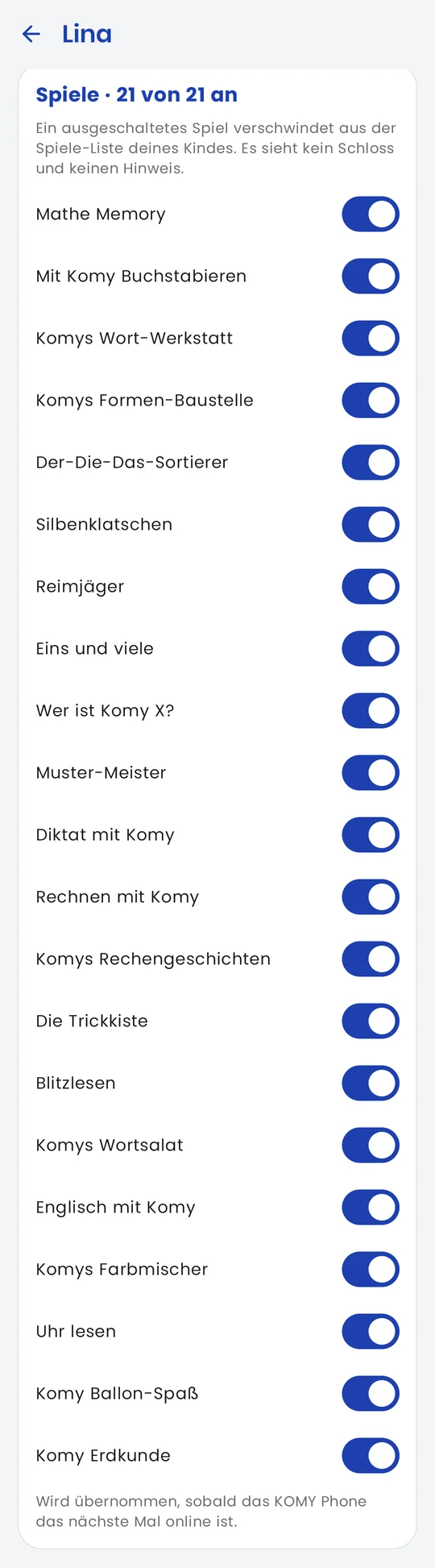
Geography with Komy: your own home, the way to school, the points of the compass. Plus twenty-one learning games you can switch on and off one by one – played out of curiosity. In Komy’s word problems, Komy tells little maths stories from his day; your child finds the numbers, picks the operation and works it out, and Komy never gives the answer first. When something is hard, Komy patiently helps on.

  • German: Spelling with Komy, Komy’s word workshop, the der-die-das sorter, syllable clapping, rhyme hunter, one and many, dictation with Komy, speed reading, Komy’s word salad, Komy balloon fun
  • Maths: maths memory, arithmetic with Komy, Komy’s word problems, the box of tricks, Komy’s shape building site (find the shapes or catch them), Who is Komy X?, pattern master, telling the time
  • General studies, English and art: Komy geography, English with Komy, Komy’s colour mixer
11:09
KOMY Phone, “Games” page: all twenty-one learning games sorted by subject
All twenty-one on the KOMY Phone – scroll through them.
11:09
Parents’ app: games, 21 of 21 on, one switch per game
In the parents’ app: one switch per game.
And what Komy never does: grade, compare. The KOMY Phone has no rankings, no grades and no performance reports. Not hidden in the settings – simply never built.

Curiosity knows no limits.

The KOMY Phone holds a whole children’s encyclopedia to browse – 5,107 articles in German, without the internet. Not a chatbot that makes up answers, but a checked encyclopedia for children, edited by adults.

  • Two encyclopedias in one. The complete Klexikon with 3,527 articles and the MiniKlexikon with 1,580 articles in simpler language. Which texts your child sees follows their reading level.
  • Twelve fields of knowledge with their own picture tiles – geography, animals and nature, science and technology, history and eight more. Links lead from article to article.
  • A search that forgives typos. Type “Elefand” and you find the Elefant. And if you don’t know what you are looking for, press “Zeig mir was!” – show me something.
  • You decide about sensitive topics. War and violence, death, body and sexuality, addiction, crime – about 140 articles stay invisible until you switch them on in the parents’ app.
  • It is your child’s own book. Komy never reads from it and never answers with it. And what your child looks up is not recorded.

Did you mean …

ElefantAnimals and nature

Content from the Klexikon and MiniKlexikon of the Zentrale für Unterrichtsmedien (ZUM), licence CC BY-SA. The Klexikon is an independent project; Sysea is not affiliated with ZUM.